HEY GUYS!!! TODAY'S QUESTION IS ABOUT WHY IS IT HARD TO HIT FLIES? SO LETS GOOOOOOOO...................
Why is it so hard to hit flies?
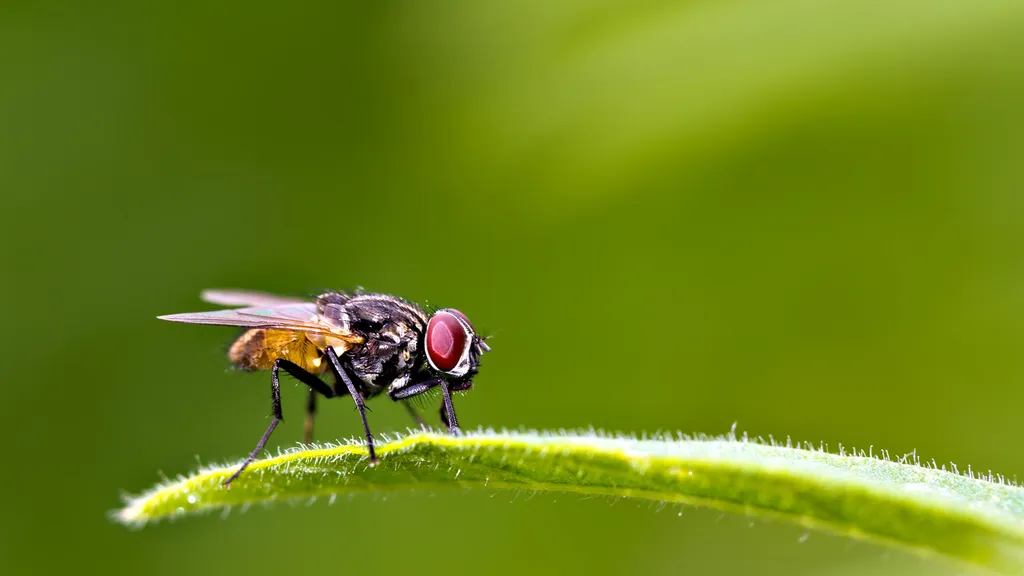
A fly buzzes past your head and lands nearby; you snatch a flyswatter or roll up a magazine and approach cautiously — and you strike!
But no matter how quick you are, the fly is almost always faster, and it usually manages to evade your wallop and escape unharmed. (Is it trying to annoy you?!)
Flies have many adaptations that lend them heightened speed, maneuverability and perception, making them very, very good at detecting and evading even the swiftest swats. And new evidence shows that flies' modified hind wings play an important part in launching them into a speedy takeoff — often just in the nick of time.
House flies (Musca domestica) belong to the order Diptera, or true flies. Diptera flies possess modified hind wings that have evolved into tiny, sticklike structures with a knob at the end, called halteres. Their vibrations help the insects stabilize their bodies while in flight, by sensing body rotations and transmitting information to the wings.
Flies in the Diptera subgroup Calyptratae, which includes house flies, also vibrate their halteres while walking, but scientists didn't know why. In a study published online Jan. 13, 2021 in the journal Proceedings of the Royal Society B: Biological Sciences, researchers investigated Calyptratae flies to see if haltere oscillation affected their transition into the air, directing additional sensory input to help coordinate movements in the wing and leg muscles.
Using high-speed cameras to capture tethered and free laboratory-reared flies during takeoff, the scientists recorded footage at speeds up to 3,000 frames per second. They found that Calyptratae flies launched themselves around five times faster than other flies; their takeoffs required an average of about 0.007 seconds (7 milliseconds) and just one wingbeat.
"None of the Calyptratae had a takeoff duration longer than 14 milliseconds [0.014 seconds]," the researchers reported. By comparison, non-Calyptratae flies' takeoffs lasted about 0.039 seconds (39 milliseconds) and required about four wingbeats, according to the study.
House flies (Musca domestica) belong to the order Diptera, or true flies. Diptera flies possess modified hind wings that have evolved into tiny, sticklike structures with a knob at the end, called halteres. Their vibrations help the insects stabilize their bodies while in flight, by sensing body rotations and transmitting information to the wings.
Flies in the Diptera subgroup Calyptratae, which includes house flies, also vibrate their halteres while walking, but scientists didn't know why. In a study published online Jan. 13, 2021 in the journal Proceedings of the Royal Society B: Biological Sciences, researchers investigated Calyptratae flies to see if haltere oscillation affected their transition into the air, directing additional sensory input to help coordinate movements in the wing and leg muscles.
Using high-speed cameras to capture tethered and free laboratory-reared flies during takeoff, the scientists recorded footage at speeds up to 3,000 frames per second. They found that Calyptratae flies launched themselves around five times faster than other flies; their takeoffs required an average of about 0.007 seconds (7 milliseconds) and just one wingbeat.
"None of the Calyptratae had a takeoff duration longer than 14 milliseconds [0.014 seconds]," the researchers reported. By comparison, non-Calyptratae flies' takeoffs lasted about 0.039 seconds (39 milliseconds) and required about four wingbeats, according to the study.
Animal brains perceive the passage of time by processing images at speeds known as the "flicker fusion rate," a term describing how many images flash into their brains per second. Roger Hardie, a professor emeritus of cellular neuroscience at the University of Cambridge in England, implanted electrodes into the photoreceptors of flies' eyes to measure their flicker fusion rate, calculating it to be 400 times per second; the average flicker fusion rate for humans is about 60, according to the BBC. This means that movement you perceive as "normal" moves like slow-motion to a fly.
With all these built-in advantages, it's no wonder that the fly you're trying to swat can escape. However, one approach that might improve your chances is aiming your swat at a spot where the fly is likely to go, rather than where it's resting, Michael Dickinson of the California Institute of Technology in Pasadena told The Independent in 2011.
"It is best not to swat the fly's starting position," Dickinson said. "Aim a bit forward of that to anticipate where the fly is going to jump."
Then again, you could also just leave the fly alone, Yarger added. "They have just as much right to survival as any other animal," she said.
EDITOR'S NOTE: The article was updated at 11:35 a.m. ET on Jan. 13 to include quotes from the lead researcher and video of experiments.
BYEE EVERYONE. I MEET YOU AT 1:00 P.M. IN ANOTHER POST
Comments
Post a Comment